
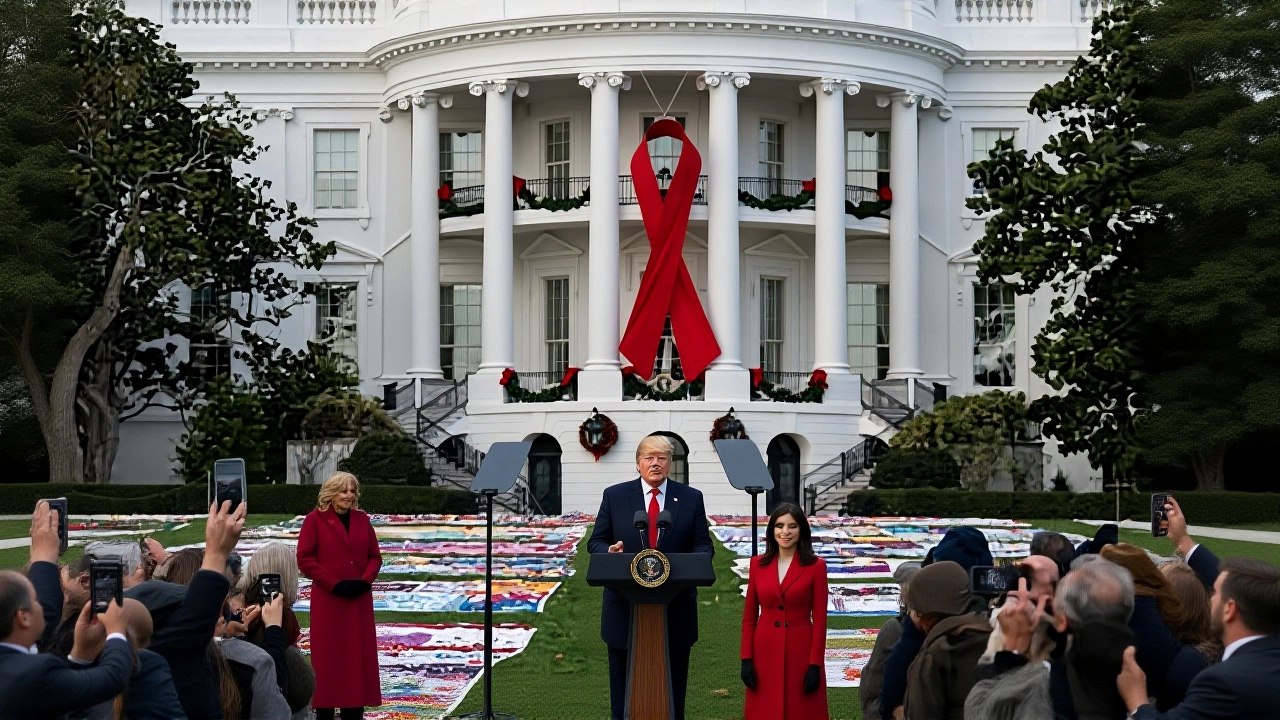
On December 1, 2025, the world marked World AIDS Day — a global observance since 1988 — with candlelight vigils, public health rallies, and tributes to the more than 44 million lives lost to AIDS-related illnesses. But in Washington, D.C., the silence was deafening. For the first time in history, the Trump administration issued a directive barring all federal agencies from participating in any official commemoration. No presidential proclamation. No White House event. No statements from the U.S. Department of State or the Centers for Disease Control and Prevention (CDC). Just silence.
A Tradition Broken
Since its inception in 1988, every U.S. president — Republican and Democrat alike — has issued a proclamation for World AIDS Day. The day wasn’t just symbolic; it was a strategic checkpoint. Presidents used it to announce new funding, expand testing programs, or honor activists. In 2003, President George W. Bush launched PEPFAR on this very day. In 2017, President Donald J. Trump himself pledged $5 billion more to the program — a move hailed as historic. This year, the Trump administration did the opposite. According to a PBS NewsHour report aired December 1, 2025, federal agencies were explicitly instructed not to host events, release statements, or even post social media content about the day. The directive came amid sweeping cuts to global health aid, though the exact figures remain unconfirmed. What’s clear: the U.S. is stepping back from its role as the world’s largest funder of HIV/AIDS programs.The PEPFAR Paradox
PEPFAR is the backbone of the global response to HIV/AIDS. Since 2003, it has provided antiretroviral treatment to 18.96 million people — mostly in sub-Saharan Africa, where the epidemic remains most severe. It funds testing, prevention, and mother-to-child transmission programs in over 50 countries, including Nigeria, South Africa, and Kenya. Now, that lifeline is fraying. The administration’s broader foreign aid review, launched in January 2025, targets not just PEPFAR but also malaria and tuberculosis programs managed by the U.S. Agency for International Development (USAID). The message? Aid must be "transactional," not humanitarian. Dr. Demetre Daskalakis, who led HIV prevention at the CDC until 2023, put it bluntly in the PBS NewsHour segment: "I think it signals that this is not a priority." He added, "So the strategy is already being unplugged by the administration — and the commemoration day is just a symptom of that bigger disease. That disease is a lack of concern. They are looking at PEPFAR as transactional, trying to figure out ways to trade aid for..." The audio cut off there. But the implication was chilling: aid might be used as leverage in diplomatic negotiations, not saved lives.The State Department’s Defense
The U.S. Department of State responded to media inquiries with a statement: "An awareness day is not a strategy. Under the leadership of President Donald J. Trump we are working to save lives and increase responsibility and burden sharing... but globally, and save millions of lives." That line — "an awareness day is not a strategy" — is technically true. But it’s also a distraction. For decades, the U.S. treated World AIDS Day as a launchpad for strategy. It wasn’t just about remembering the dead; it was about rallying the world. In 2011, President Obama used the day to announce a new initiative to eliminate mother-to-child transmission in 21 countries. In 2020, then-Secretary of State Mike Pompeo announced a $500 million pledge to expand pediatric care. Now, the administration wants to reframe aid as a bilateral deal — not a moral commitment. But in regions where governments lack resources, that shift is catastrophic. When the U.S. pulls back, clinics close. Test kits vanish. PrEP pills disappear from pharmacies. People stop getting tested because the fear of stigma returns without the safety net of federal support.What’s at Stake
The United Nations aims to end AIDS as a public health threat by 2030. That requires treating 34 million people and preventing 1.2 million new infections each year through 2025. The U.S. currently funds nearly half of all global HIV/AIDS spending. If funding drops by even 20%, experts estimate up to 500,000 additional deaths could occur by 2027 — mostly in Sub-Saharan Africa. And it’s not just about survival. It’s about trust. When a country abandons its global health commitments, others follow. The European Union and Canada may reduce their contributions. Private donors like the Gates Foundation may scale back. The ripple effect is already visible: in Lusaka, Zambia, a clinic that served 12,000 patients last year now has only enough medication for 7,000. The rest? They’re waiting.What’s Next?
No official deadlines have been announced, but the UNAIDS global update is due in June 2026. That report will show whether the U.S. withdrawal has accelerated transmission. Meanwhile, state and local health departments, nonprofits, and faith-based groups are scrambling to fill the gap. In Atlanta, the CDC still has staff working on global HIV programs — but without federal funding, their ability to coordinate overseas efforts is shrinking. The most dangerous consequence? Normalization. When a nation stops marking the deaths of millions, it stops seeing them as human. And when the world stops seeing the U.S. as a leader in health equity, it stops looking to it for solutions.Frequently Asked Questions
How does this affect people living with HIV in Africa?
The U.S. funds nearly half of all HIV treatment in sub-Saharan Africa. If PEPFAR funding is cut, an estimated 2.5 million people could lose access to antiretroviral therapy by 2027. Without daily medication, viral loads rise, transmission increases, and death rates climb. In countries like South Africa, where 7.5 million people live with HIV, the collapse of U.S.-funded clinics could reverse 20 years of progress.
Why is World AIDS Day so important if it’s just a day?
It’s not just a day — it’s a global accountability mechanism. For 37 years, it forced governments to report progress, announce funding, and honor those lost. It mobilized donors, inspired activism, and kept the epidemic in the public eye. Removing it signals that the U.S. no longer sees HIV/AIDS as a moral or strategic priority — and that emboldens other nations to follow suit.
Has any other administration ever skipped World AIDS Day?
No. Every president since Ronald Reagan in 1988 has issued a proclamation. Even during the height of the opioid crisis or the Ebola outbreak, the U.S. never canceled the observance. The Trump administration’s decision is unprecedented — and has been condemned by former officials from both parties, including former Secretary of State Colin Powell and former CDC Director Dr. Tom Frieden.
What’s the connection between PEPFAR cuts and global health security?
HIV programs are often the first line of defense in global health surveillance. The same labs that test for HIV also detect new variants of other diseases. The same community health workers who deliver antiretrovirals also distribute vaccines and report outbreaks. When PEPFAR funding drops, so does the world’s early warning system — making future pandemics harder to contain.
Is there any pushback happening?
Yes. Over 120 U.S. mayors, including those from New York, Los Angeles, and Chicago, have issued their own proclamations for World AIDS Day. Nonprofits like the Global Fund and amfAR have pledged to cover 30% of the projected funding gap. But these efforts are piecemeal — no substitute for the scale and coordination of federal leadership.
When will we know the full impact of these cuts?
The next major assessment comes in June 2026, when UNAIDS releases its global update. But preliminary data from clinics in Kenya and Malawi already show a 15% drop in new HIV tests since January 2025. Without testing, there’s no treatment. Without treatment, there’s no control. The numbers won’t lie — and they’ll be devastating.





Cheryl Jonah
December 4, 2025 AT 14:47They’re not skipping it because they don’t care - they’re skipping it because they KNOW how powerful it is. This is a distraction tactic. The media’s been lying about PEPFAR for years. The real story? The money was being funneled into corrupt African governments while American clinics went under. Now they’re finally cutting the waste. 🤷♀️
James Otundo
December 5, 2025 AT 12:23Look, I get the performative outrage, but let’s be real - World AIDS Day is just woke theater. The real issue is systemic corruption in the global aid pipeline. PEPFAR was never about saving lives; it was about projecting American soft power while African bureaucrats got rich. The administration’s just calling the bluff. If you actually cared about people, you’d demand accountability, not candlelight.
Sarah Day
December 6, 2025 AT 08:03I work at a community health center in Ohio, and we’ve got folks coming in who’ve been on PrEP for years because of PEPFAR’s outreach programs. I’ve seen the impact firsthand - it’s not just about Africa. The training, the labs, the protocols - they all came from U.S. investment. Cutting this isn’t fiscal responsibility. It’s just… cruel. We’re not just losing funding, we’re losing trust.
ryan pereyra
December 7, 2025 AT 14:35Let’s deconstruct this performative moralism. The rhetorical framing of World AIDS Day as a ‘global accountability mechanism’ is a neoliberal mythos designed to legitimize biopolitical interventionism. The U.S. has functioned as a hegemonic health patron, not a humanitarian actor - and now, with the strategic realignment of global health governance under the Trump Doctrine™, we’re witnessing the collapse of the aid-industrial complex. PEPFAR was never sustainable. It was a rent-seeking apparatus disguised as altruism.
Jane Roams Free
December 9, 2025 AT 06:55I’ve been in Kenya for 12 years working with local clinics. When the U.S. steps back, the women who used to get tested at mobile units just… disappear. No one talks about it. But I’ve seen the empty shelves. I’ve held the hands of mothers who lost their babies because the meds ran out. This isn’t politics. This is people. And we’re not just losing funding - we’re losing dignity.
Anthony Watkins
December 11, 2025 AT 05:35Who cares? We got our own problems. Why are we paying for Africa’s mess? They don’t even clean up their own streets. If they want help, they need to start helping themselves. 🇺🇸💪
Bryan Kam
December 11, 2025 AT 13:08They didn’t skip the day. They just stopped pretending.
Cheri Gray
December 13, 2025 AT 09:09i just read this and i’m crying. not because of the politics but because last year i met a little girl in johannesburg who got her meds because of pepfar. she’s 8 now. she’s alive. and now? no one knows. this isn’t a headline. it’s a heartbeat.
Andrea Hierman
December 15, 2025 AT 02:31It is, without question, a profound moral failure - one that transcends partisan politics. The symbolic erasure of World AIDS Day is not merely an administrative decision; it is the institutionalization of indifference. To withdraw from a 37-year global covenant - one that saved millions - is to declare that human life, particularly the lives of the marginalized, is expendable when convenience supersedes conscience. This is not leadership. This is abandonment.
Christine Dick
December 16, 2025 AT 08:05And yet, no one dares to ask: Why should American taxpayers fund the consequences of African governments’ refusal to prioritize their own citizens? Why are we enabling dependency? Why are we rewarding corruption? The truth is, this isn’t about compassion - it’s about enabling a system that thrives on victimhood. The U.S. has been the world’s patsy for decades. It’s time to stop.
Jullien Marie Plantinos
December 17, 2025 AT 03:25PEPFAR was a disaster. Billions wasted. No accountability. And now they want us to feel guilty for finally saying NO? Wake up. We’re not the world’s nurse. We’re not the world’s bank. If other countries want to save lives, they can pay for it themselves. We’ve got veterans to care for, schools to fix, and borders to secure. This isn’t cruel - it’s common sense.